MLA-2
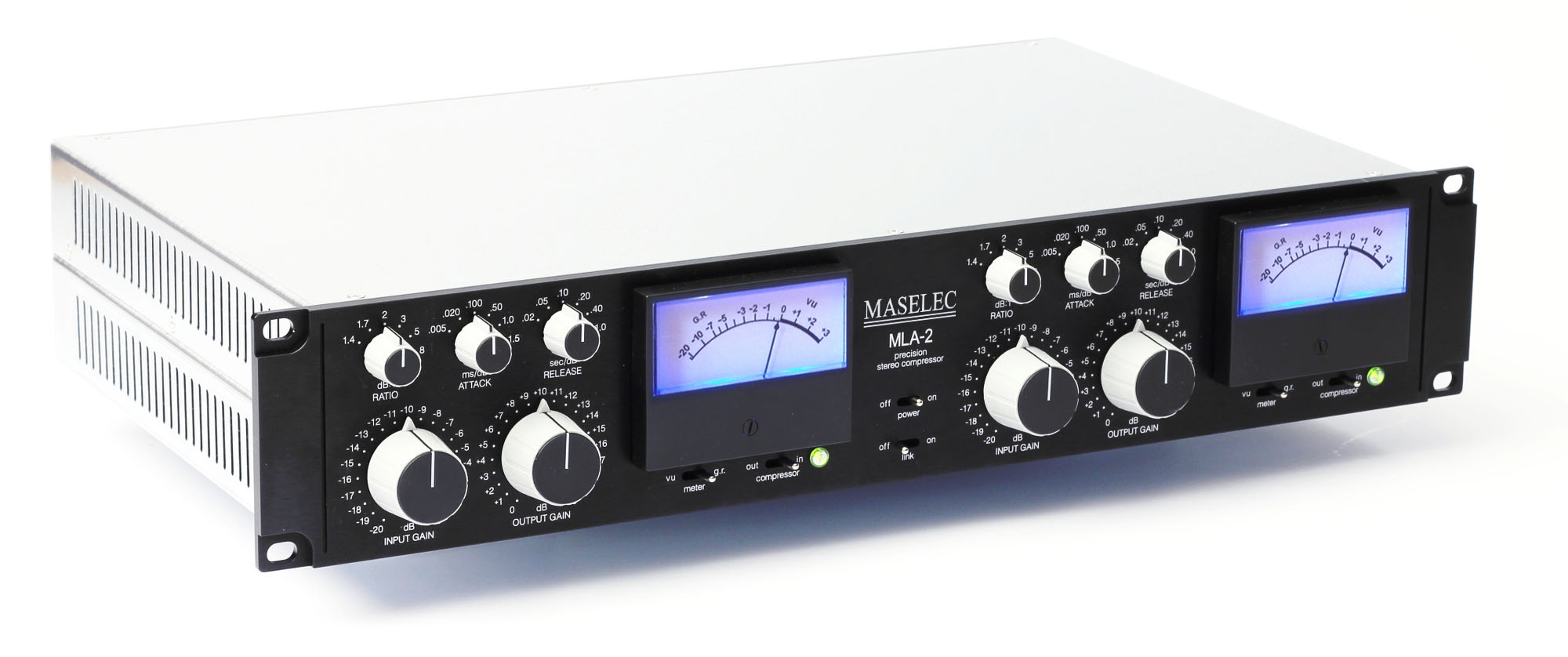
Overview
The MLA-2 is a stereo or 2-channel compressor with stepped drive (input gain), ratio, attack and release time and output gain controls. For optimum transparency and freedom from noise the MLA-2 employs a non-VCA design.
Applications
Top recording and mastering engineers still use some analogue signal processing equipment, finding the familiar correlation between sound and control better to work with. However, most analogue compressors have either continuously variable controls, making precise adjustments difficult, or just a few coarsely-stepped controls. Many fail to meet the standards of audio performance consistent with digital media. The MLA-2 provides fully-stepped controls for precision and repeatability for ALL parameters.
The MLA-2 is extensively used in mastering but also works well on an insertion point in recording or mixing. The MLA-2 has a rear-mounted range control switch that adjusts the threshold range to suit either mastering or recording/mixing applications.
The MLA-2 is a compressor that can provide effective dynamic control with minimal side-effects - it is designed to provide a very transparent signal path.
Pedigree and design philosophy
The combination of Leif Mases' experience with the creative process and engineering and technical excellence ensure that the Maselec MLA-2 delivers great-sounding audio in an intuitive and easy-to-use package.
Using the MLA-2
The MLA-2 is a very special Compressor that has been designed to provide effective but subtle compression. It uses the principle of a fixed threshold, with adjustable drive (or input gain). This makes for more intuitive operation than an adjustable threshold - turn the drive control clockwise and increase the compression depth.
The progression into the compression region is gradual and changes as the ratio is increased. Minimal output gain make-up adjustment is needed as the threshold is slightly modified running through different ratio settings. This creates a consistent gain point with about 2-3dB of compression across the ratio range.
The MLA-2 automatically adjusts its attack and release times based on the front panel setting for the most musical result. In addition, a modified release decay is used rather than the conventional exponential curve.
The MLA-2 IMAGELINK system provides a stereo side-chain link that allows the gain of the two channels to track so avoiding the risk of stereo image shifting when only one channel is controlled. However, transients that are placed to the extreme right or left can result in a slightly un-natural ducking of the other channel, so the stereo link is controlled to avoid this.
The MLA-2 achieves excellent results with speech and other highly dynamic sources, as well as instruments such as piano, saxophone or drums. It has a distinctive character, discernable both sonically and in the unique shape of its progressive compression curves. It provides the warmth, punch or air you need with a minimum of effort and without compromising the signal path.